The 2026 Home Addition Cost Index: $200–$280 per Square Foot, by State
We pulled home addition costs for all 50 states using 2026 regional pricing. A 300 sq ft addition runs $60,000 in the Southeast and $84,000 in the West — here's the per-square-foot breakdown and what drives the 40% gap.
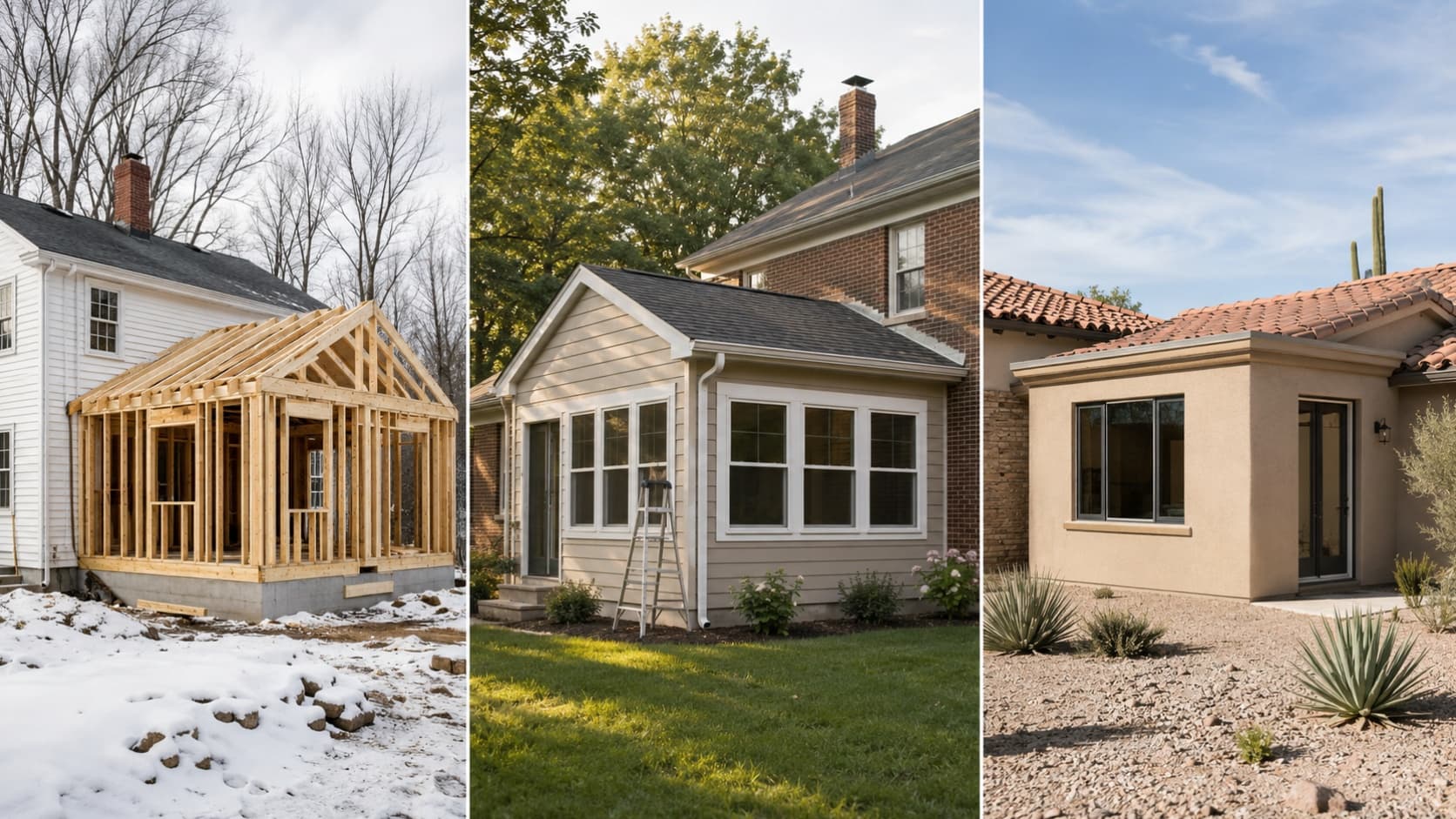
A 300 sq ft room addition costs about $84,000 in the West in 2026. The same addition — same size, same finish level — runs $60,000 in the Southeast. That's a $24,000 spread, or 40% more, for an identical project.
On a per-square-foot basis, that's the difference between $200/sq ft and $280/sq ft for finished, permitted living space tied into your existing home.
We pulled home addition costs across all 50 states using current 2026 regional pricing. Here's where building is most and least expensive, the per-square-foot breakdown most homeowners actually search for, and what drives the gap.
Get Your State's Per-Square-Foot Number
National averages hide a 40% regional spread. Get a free 2026 estimate for your specific state and addition size in 60 seconds.
Get My Addition Estimate →The Headline: $200–$280 per Square Foot, Driven by Region
A home addition's cost scales almost entirely with square footage and region. Here's the 2026 regional ranking for a typical 300 sq ft single-story addition — both total cost and the per-square-foot figure most people search for:
| Rank | Region | Per sq ft (mid) | 300 sq ft total | Total range |
|---|---|---|---|---|
| 1 | West | $280 | $84,000 | $57,000 – $126,000 |
| 2 | Northeast | $250 | $75,000 | $52,500 – $114,000 |
| 3 | Midwest | $210 | $63,000 | $42,000 – $97,500 |
| 3 | Southwest | $210 | $63,000 | $42,000 – $97,500 |
| 5 | Southeast | $200 | $60,000 | $39,000 – $93,000 |
The West-vs-Southeast gap of $80/sq ft ($24,000 on a 300 sq ft addition) is the headline. Major metros push 10–20% above their regional baseline on top of this.
What Actually Drives the Regional Gap
Home additions are more labor-intensive than freestanding structures because they have to tie into an existing house. Three factors do most of the work:
1. Skilled labor cost. A finished addition involves framing, roofing, electrical, plumbing, HVAC, insulation, drywall, and finish trades — 400–700 labor hours for 300 sq ft. At West Coast wage rates (carpenters $45–$55/hr, electricians $60–$90/hr) versus Southeast rates (often 40–50% lower), labor alone explains most of the spread. That's why our data shows labor at 55% of total cost in the West versus 45% in the Southeast.
2. Tie-in complexity and code. Additions must match the existing foundation depth (frost footings run 42–60" in the North, 12" in the South), match rooflines, and bring the connection up to current code. Northern climates also require higher insulation values (R-21+ walls, R-49+ ceilings) and tend toward more expensive HVAC extensions.
3. Permit and review overhead. A permitted addition triggers structural, electrical, and plumbing inspections everywhere — but fees and review timelines vary widely. Coastal and metro jurisdictions (especially in the Northeast and West) add design review and impact fees that the rural Southeast doesn't.
Where the Region Story Breaks Down: Major Metros
Regional averages flatten metro-specific dynamics. Our city-level data captures the adjustment for high-demand metros:
| Metro | Region | Multiplier | Adjusted 300 sq ft total | Why |
|---|---|---|---|---|
| Boston, MA | Northeast | 1.20× | $90,000 | Historic district rules, design review, $100+/hr carpenter labor |
| Grand Rapids, MI | Midwest | 1.00× | $63,000 | At the regional baseline; competitive contractor market |
| Houston, TX | Southwest | 0.95× | $59,850 | High contractor supply, no state income tax, but expansive-soil foundations |
A Boston addition at $90,000 ($300/sq ft) is 50% more than the same 300 sq ft addition in rural Georgia.
The Hidden Cost Layer
The figures above assume a standard single-story addition with a slab or crawlspace foundation, matching siding and roofing, and mid-grade interior finishes. Common cost drivers that don't show up in per-square-foot averages:
| Cost driver | Typical add-on |
|---|---|
| Extending or adding HVAC (vs. a mini-split) | $3,000 – $8,000 |
| Matching existing siding & roofing (older homes) | $2,000 – $6,000 |
| Electrical panel upgrade (if at capacity) | $1,500 – $4,000 |
| Structural engineering + permits | $1,000 – $5,000 |
| Second-story addition (reinforcing below) | +20–40% over single-story |
| Bathroom or kitchen plumbing in the addition | $5,000 – $20,000 |
Second-story additions and additions containing a bath or kitchen are where budgets blow up — those can push a 300 sq ft project well past six figures even in lower-cost regions. Budget for the high end of the range, not the mid.
How To Use This Data When Planning Your Addition
- Anchor on your region's per-square-foot number, not a national average. "Home additions cost about $230/sq ft nationally" is useless if you're in Oregon ($280) or Mississippi ($200). Start with your region's figure from the table above and multiply by your square footage.
- Add a metro multiplier if you're in a major city. Boston, NYC, San Francisco, Seattle, and similar markets run 15–25% above their regional baseline.
- Decide single- vs. two-story early. It's the single biggest cost lever after region. A two-story addition costs more per square foot but often less per usable square foot if you need the space.
Get the Exact Number for Your State and Size
Our free calculator handles state-by-state pricing, addition size, and finish level — no signup required.
Calculate My Addition Cost →Full 50-State Ranking
Every state ranked by mid-range cost for a typical 300 sq ft single-story home addition in 2026. Click any state for the detailed local guide with permits, contractor questions, and a free instant estimate.
| Rank | State | Region | Per sq ft | 300 sq ft total |
|---|---|---|---|---|
| 1 | Alaska | West | $280 | $84,000 |
| 1 | California | West | $280 | $84,000 |
| 1 | Colorado | West | $280 | $84,000 |
| 1 | Hawaii | West | $280 | $84,000 |
| 1 | Idaho | West | $280 | $84,000 |
| 1 | Montana | West | $280 | $84,000 |
| 1 | Nevada | West | $280 | $84,000 |
| 1 | Oregon | West | $280 | $84,000 |
| 1 | Utah | West | $280 | $84,000 |
| 1 | Washington | West | $280 | $84,000 |
| 1 | Wyoming | West | $280 | $84,000 |
| 12 | Connecticut | Northeast | $250 | $75,000 |
| 12 | Delaware | Northeast | $250 | $75,000 |
| 12 | Maine | Northeast | $250 | $75,000 |
| 12 | Maryland | Northeast | $250 | $75,000 |
| 12 | Massachusetts | Northeast | $250 | $75,000 |
| 12 | New Hampshire | Northeast | $250 | $75,000 |
| 12 | New Jersey | Northeast | $250 | $75,000 |
| 12 | New York | Northeast | $250 | $75,000 |
| 12 | Pennsylvania | Northeast | $250 | $75,000 |
| 12 | Rhode Island | Northeast | $250 | $75,000 |
| 12 | Vermont | Northeast | $250 | $75,000 |
| 23 | Arizona | Southwest | $210 | $63,000 |
| 23 | Illinois | Midwest | $210 | $63,000 |
| 23 | Indiana | Midwest | $210 | $63,000 |
| 23 | Iowa | Midwest | $210 | $63,000 |
| 23 | Kansas | Midwest | $210 | $63,000 |
| 23 | Michigan | Midwest | $210 | $63,000 |
| 23 | Minnesota | Midwest | $210 | $63,000 |
| 23 | Missouri | Midwest | $210 | $63,000 |
| 23 | Nebraska | Midwest | $210 | $63,000 |
| 23 | New Mexico | Southwest | $210 | $63,000 |
| 23 | North Dakota | Midwest | $210 | $63,000 |
| 23 | Ohio | Midwest | $210 | $63,000 |
| 23 | Oklahoma | Southwest | $210 | $63,000 |
| 23 | South Dakota | Midwest | $210 | $63,000 |
| 23 | Texas | Southwest | $210 | $63,000 |
| 23 | Wisconsin | Midwest | $210 | $63,000 |
| 39 | Alabama | Southeast | $200 | $60,000 |
| 39 | Arkansas | Southeast | $200 | $60,000 |
| 39 | Florida | Southeast | $200 | $60,000 |
| 39 | Georgia | Southeast | $200 | $60,000 |
| 39 | Kentucky | Southeast | $200 | $60,000 |
| 39 | Louisiana | Southeast | $200 | $60,000 |
| 39 | Mississippi | Southeast | $200 | $60,000 |
| 39 | North Carolina | Southeast | $200 | $60,000 |
| 39 | South Carolina | Southeast | $200 | $60,000 |
| 39 | Tennessee | Southeast | $200 | $60,000 |
| 39 | Virginia | Southeast | $200 | $60,000 |
| 39 | West Virginia | Southeast | $200 | $60,000 |
States within the same region share base pricing in this data set; metro-specific variation is captured in the detailed state and city guides linked above.
Methodology
This index uses BuildCost's 2026 regional cost data, derived from contractor pricing surveys, materials cost indexes, and labor wage data across the five U.S. construction regions. Regional per-square-foot multipliers are applied to a standard 300 sq ft single-story home addition with a slab or crawlspace foundation, matching siding and roofing, standard electrical and HVAC tie-in, and mid-grade interior finishes.
City-level multipliers (Boston, Grand Rapids, Houston) are based on metro-specific labor cost and permit-fee data.
Cost ranges include: framing, roofing, electrical, HVAC tie-in, insulation, drywall, mid-grade interior finishes, standard site prep, and permits.
Cost ranges do not include: land cost, second-story structural reinforcement, kitchen or bathroom plumbing fixtures, high-end finishes, or financing costs.
For the current pricing on your specific state, city, and addition size, use our free Home Addition Cost Calculator. For city-specific guidance, see our Boston, Grand Rapids, and Houston home addition cost guides.
Founder of BuildCost. Combines hands-on construction and trades experience with years of managing his own home renovation projects and a data and research background that drives how BuildCost aggregates and regionalizes cost data.
More about Michael →