The 2026 Detached Garage Cost Index: A 35% Spread Across the 50 States
We pulled detached garage costs across all 50 U.S. states using 2026 regional pricing. The same 576 sq ft 2-car garage costs $9,792 more in California than in Georgia — and the patterns show why.
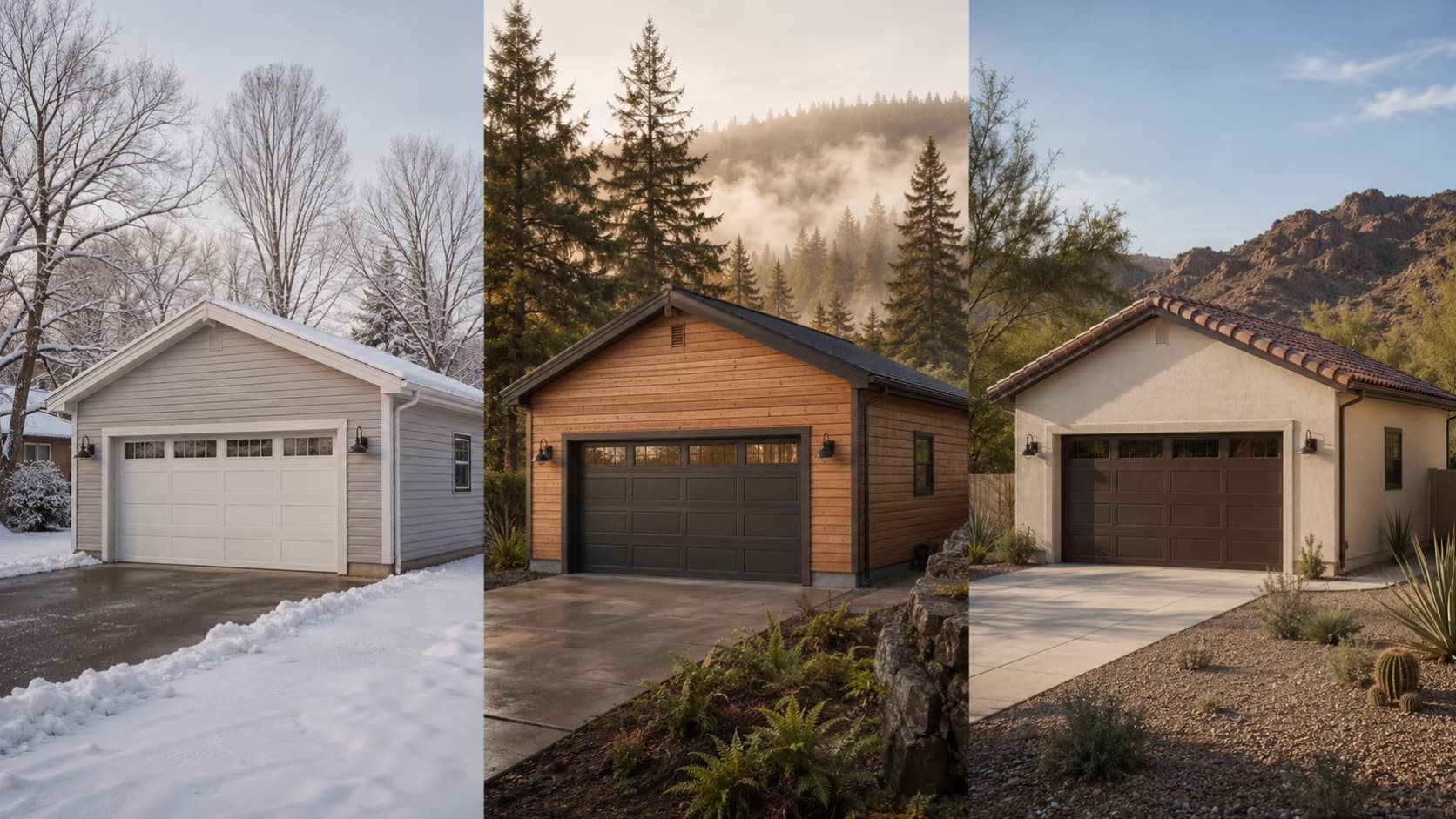
A homeowner in California pays about $37,440 to build a 2-car detached garage in 2026. The same structure — same 576 sq ft, same slab, same overhead door, same asphalt shingles — costs $27,648 in Georgia. That's a $9,792 spread, or 35% more, for an identical building.
This isn't a story about lumber prices or tariff swings. It's about regional labor markets, climate code requirements, and permit overhead — the underlying cost structure most "national average" headlines flatten away.
We pulled detached garage costs across all 50 states using current 2026 regional pricing. Here's where building is most and least expensive, what actually drives the gap, and how to use the data when planning your own build.
Get Your State's Real Number, Not a National Average
A "national average" garage cost doesn't tell you anything actionable. Get a free 2026 estimate for your specific state and size in 60 seconds.
Get My Garage Estimate →The Headline: A 35% Spread, Driven By Region Not State
Build a 576 sq ft 2-car detached garage in 2026 and your typical mid-range cost lands somewhere between $27,648 and $37,440 depending on the region. Within any single region — say, the eleven Northeast states — pricing is essentially uniform because the underlying drivers (union labor density, frost depth, energy code, permit overhead) operate on a regional rather than state-level scale.
Here's the regional ranking by mid-range total cost:
| Rank | Region | Mid total cost | Per sq ft | States covered |
|---|---|---|---|---|
| 1 | West | $37,440 | $65 | 11 (CA, OR, WA, CO, NV, AZ-adjacent, etc.) |
| 2 | Northeast | $33,408 | $58 | 11 (NY, MA, PA, NJ, CT, etc.) |
| 3 | Midwest | $28,800 | $50 | 12 (IL, MI, OH, MN, etc.) |
| 3 | Southwest | $28,800 | $50 | 4 (TX, AZ, NM, OK) |
| 5 | Southeast | $27,648 | $48 | 12 (FL, GA, NC, TN, etc.) |
The West-vs-Southeast gap of $9,792 is the headline number. But there are also significant within-region variations — particularly in major metros where dense urban labor markets push costs above their regional baseline by 10–20%.
What Actually Drives the Regional Gap
Three factors do most of the work:
1. Skilled labor cost. Carpenters in the Bay Area earn ~$50/hour straight time; in rural Alabama, the same trade runs ~$25/hour. A detached garage takes 200–300 labor hours from framing through trim — multiply that out and you get the bulk of the West-Southeast premium. This is why our regional cost data shows labor running 55% of total cost in the West vs 45% in the Southeast: same materials, more expensive hands.
2. Climate code requirements. Frost depth dictates foundation depth. The Northeast and Upper Midwest require frost footings 42–60" deep; the Southeast typically needs 12" or less. That's 3–5× the concrete on the same footprint. Snow load adds rafter density (Minneapolis requires 35 psf minimum vs Florida's 20 psf). The West's high seismic zones require shear bracing that the Southeast doesn't.
3. Permit and inspection overhead. A detached garage permit in Boston runs $1,500–$3,500 once design review is required. In Chicago: $200–$450 through the Department of Buildings. In unincorporated rural Tennessee: often $50–$200. Aggregate the variation across each region's metros and the average drifts up or down.
(Material costs vary less than you'd expect — lumber, concrete, and steel pricing is set on national supply chains and rarely diverges more than 5–10% across regions. The cost difference is mostly labor and code.)
Where the Region Story Breaks Down: Major Metros
Regional averages flatten metro-specific dynamics. Building a garage in Boston is meaningfully more expensive than building one in rural Vermont, even though both are Northeast. Our city-level cost data captures these adjustments for major metros:
| Metro | Region | Multiplier | Adjusted mid cost | Why |
|---|---|---|---|---|
| Boston, MA | Northeast | 1.20× | $40,090 | Historic district restrictions, design review fees, $100+/hr carpenter labor |
| Denver, CO | West | 1.10× | $41,184 | Strong demand, growing metro, deep frost footings above 6,000 ft |
| Chicago, IL | Midwest | 1.15× | $33,120 | Union labor rates, dense urban demolition fees, alley-access constraints |
| Minneapolis, MN | Midwest | 1.10× | $31,680 | 60" frost depth, heated-build complexity, short building season |
A Boston detached garage at $40,090 is 45% more than the same structure in rural Georgia. A Denver garage at $41,184 is 49% more. These aren't outliers — they're typical for the metros.
If you live in a major metro, your regional baseline understates your real cost. Add 10–20% to the regional number to get a more accurate planning anchor.
The Hidden Cost Layer
The headline numbers above assume a "standard build": slab foundation, single-story, vinyl siding, asphalt shingles, one overhead door, basic electrical rough-in. Common upgrades that don't show up in regional averages but routinely add to budgets:
| Upgrade | Typical add-on |
|---|---|
| Heating (insulated and conditioned space) | $3,000–$8,000 |
| Second-story or attic storage | $5,000–$15,000 |
| Removal of an existing garage | $4,000–$8,000 |
| Site prep for sloped or rocky lots | $1,500–$6,000 |
| Permit-triggered electrical service upgrade | $500–$3,000 |
| Higher-end finishes (siding, doors, lighting) | 15–30% on the total |
Most homeowners we see end up 10–20% over the initial mid-range estimate once these layer in. Budget for the high-end range, not the mid.
How To Use This Data When Planning Your Build
If you're planning a detached garage in 2026, three takeaways:
1. Use your region as the anchor, not a national average. A "national average" of around $31,000 doesn't tell you anything actionable if you live in Oregon ($37K) or Mississippi ($28K). Start with your region's mid-range number from the table above.
2. Add a city multiplier if you're in a major metro. Boston, Chicago, Denver, Minneapolis, San Francisco, Seattle, NYC — all materially above their regional baseline. If you're in one of these markets, expect to pay 10–20% more than the state-level number.
3. Build the hidden-cost layer into your initial budget. Plan for the high-end range, not the mid. Then negotiate downward as the bids come in. Going in with the mid-range number and hoping the hidden costs don't show up is the most reliable way to end up over budget.
Get the Exact Number for Your State and Size
Our free calculator handles state-by-state pricing, project size, materials, and local labor rates — no signup required.
Calculate My Garage Cost →Full 50-State Ranking
Below is every state ranked by mid-range cost for a typical 576 sq ft 2-car detached garage in 2026. Click any state for the detailed local guide with permits, contractor questions, and a free instant estimate.
| Rank | State | Region | Mid total cost | Range |
|---|---|---|---|---|
| 1 | Alaska | West | $37,440 | $24,192 – $57,600 |
| 1 | California | West | $37,440 | $24,192 – $57,600 |
| 1 | Colorado | West | $37,440 | $24,192 – $57,600 |
| 1 | Hawaii | West | $37,440 | $24,192 – $57,600 |
| 1 | Idaho | West | $37,440 | $24,192 – $57,600 |
| 1 | Montana | West | $37,440 | $24,192 – $57,600 |
| 1 | Nevada | West | $37,440 | $24,192 – $57,600 |
| 1 | Oregon | West | $37,440 | $24,192 – $57,600 |
| 1 | Utah | West | $37,440 | $24,192 – $57,600 |
| 1 | Washington | West | $37,440 | $24,192 – $57,600 |
| 1 | Wyoming | West | $37,440 | $24,192 – $57,600 |
| 12 | Connecticut | Northeast | $33,408 | $21,888 – $51,840 |
| 12 | Delaware | Northeast | $33,408 | $21,888 – $51,840 |
| 12 | Maine | Northeast | $33,408 | $21,888 – $51,840 |
| 12 | Maryland | Northeast | $33,408 | $21,888 – $51,840 |
| 12 | Massachusetts | Northeast | $33,408 | $21,888 – $51,840 |
| 12 | New Hampshire | Northeast | $33,408 | $21,888 – $51,840 |
| 12 | New Jersey | Northeast | $33,408 | $21,888 – $51,840 |
| 12 | New York | Northeast | $33,408 | $21,888 – $51,840 |
| 12 | Pennsylvania | Northeast | $33,408 | $21,888 – $51,840 |
| 12 | Rhode Island | Northeast | $33,408 | $21,888 – $51,840 |
| 12 | Vermont | Northeast | $33,408 | $21,888 – $51,840 |
| 23 | Arizona | Southwest | $28,800 | $18,432 – $46,080 |
| 23 | Illinois | Midwest | $28,800 | $18,432 – $46,080 |
| 23 | Indiana | Midwest | $28,800 | $18,432 – $46,080 |
| 23 | Iowa | Midwest | $28,800 | $18,432 – $46,080 |
| 23 | Kansas | Midwest | $28,800 | $18,432 – $46,080 |
| 23 | Michigan | Midwest | $28,800 | $18,432 – $46,080 |
| 23 | Minnesota | Midwest | $28,800 | $18,432 – $46,080 |
| 23 | Missouri | Midwest | $28,800 | $18,432 – $46,080 |
| 23 | Nebraska | Midwest | $28,800 | $18,432 – $46,080 |
| 23 | New Mexico | Southwest | $28,800 | $18,432 – $46,080 |
| 23 | North Dakota | Midwest | $28,800 | $18,432 – $46,080 |
| 23 | Ohio | Midwest | $28,800 | $18,432 – $46,080 |
| 23 | Oklahoma | Southwest | $28,800 | $18,432 – $46,080 |
| 23 | South Dakota | Midwest | $28,800 | $18,432 – $46,080 |
| 23 | Texas | Southwest | $28,800 | $18,432 – $46,080 |
| 23 | Wisconsin | Midwest | $28,800 | $18,432 – $46,080 |
| 39 | Alabama | Southeast | $27,648 | $17,280 – $43,200 |
| 39 | Arkansas | Southeast | $27,648 | $17,280 – $43,200 |
| 39 | Florida | Southeast | $27,648 | $17,280 – $43,200 |
| 39 | Georgia | Southeast | $27,648 | $17,280 – $43,200 |
| 39 | Kentucky | Southeast | $27,648 | $17,280 – $43,200 |
| 39 | Louisiana | Southeast | $27,648 | $17,280 – $43,200 |
| 39 | Mississippi | Southeast | $27,648 | $17,280 – $43,200 |
| 39 | North Carolina | Southeast | $27,648 | $17,280 – $43,200 |
| 39 | South Carolina | Southeast | $27,648 | $17,280 – $43,200 |
| 39 | Tennessee | Southeast | $27,648 | $17,280 – $43,200 |
| 39 | Virginia | Southeast | $27,648 | $17,280 – $43,200 |
| 39 | West Virginia | Southeast | $27,648 | $17,280 – $43,200 |
States within the same region share base pricing in this data set; metro-specific variation is captured in the detailed state and city guides linked above.
Methodology
This index uses BuildCost's 2026 regional cost data, derived from contractor pricing surveys, materials cost indexes, and labor wage data across the five U.S. construction regions (Northeast, Southeast, Midwest, Southwest, West). Regional cost-per-square-foot multipliers are applied to a standard 576 sq ft 2-car detached garage with slab foundation, vinyl siding, asphalt shingles, basic electrical rough-in, and one insulated overhead door.
City-level multipliers (Boston, Chicago, Minneapolis, Denver) are based on metro-specific labor cost data and permit fee structures. They reflect typical 2-car detached garage builds in those metros and may not apply to atypical site conditions (sloped lots, demolition required, conversions, etc.).
Cost ranges include: materials, contractor labor, standard site prep, basic electrical rough-in, and standard permits.
Cost ranges do not include: land cost, demolition of an existing structure, heated/conditioned space upgrades, second-story or attic storage, paving or driveway work, landscaping, or financing costs.
For the current pricing on your specific state, city, and project size, use our free Detached Garage Cost Calculator. For city-specific guidance, see our Chicago, Denver, and Minneapolis detached garage cost guides.
Founder of BuildCost. Combines hands-on construction and trades experience with years of managing his own home renovation projects and a data and research background that drives how BuildCost aggregates and regionalizes cost data.
More about Michael →